

AI App Development Costs in Dubai: What Businesses Should Expect in 2026
Dubai’s AI ecosystem is entering a more mature phase in 2026. Businesses are no longer experimenting with isolated AI features just to follow market trends. Instead, organizations across finance, logistics, healthcare, retail, and enterprise operations are investing in AI systems that can scale reliably under real operational pressure.
Many companies still underestimate the real financial scope of AI implementation because they focus only on frontend application development or initial model integration. The larger cost drivers usually emerge later through infrastructure scaling, cloud optimization, monitoring systems, security layers, data engineering, compliance requirements, and long-term model maintenance.
That is why businesses evaluating AI app development in Dubai must understand that enterprise AI pricing is no longer just about building an application. It is about engineering production-grade systems capable of supporting long-term operational growth.
Code Brew Labs has positioned itself as a production-first AI development partner focused on scalable architecture, lifecycle optimization, and enterprise AI deployment. Rather than approaching AI as a standalone feature set, the company emphasizes infrastructure readiness, monitoring discipline, and measurable business outcomes.
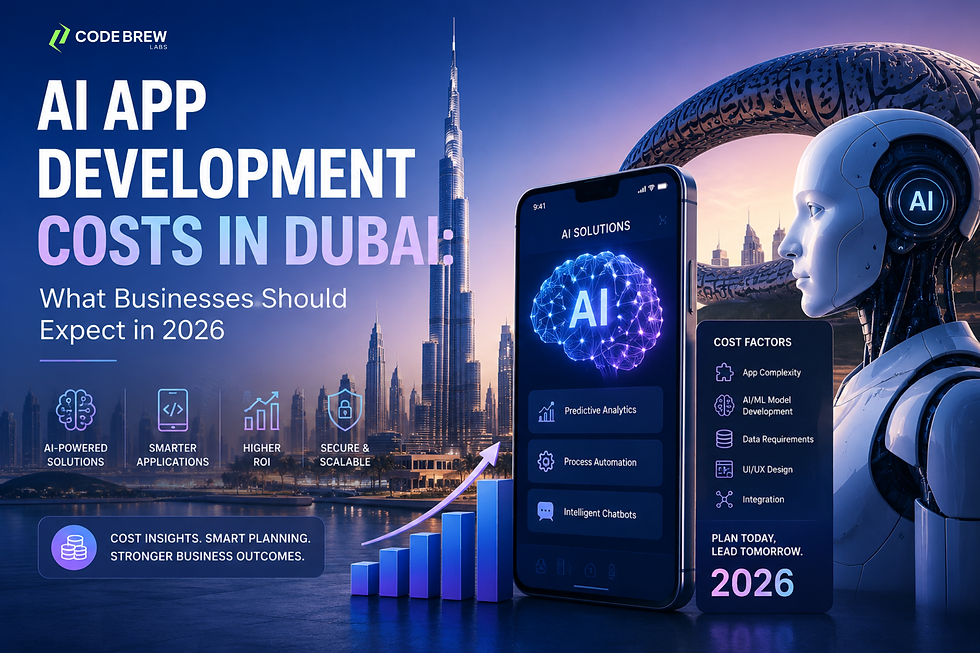
Why AI Development Costs Are Rising in Dubai
Dubai’s rapid digital transformation initiatives and enterprise AI adoption are increasing the demand for specialized development capabilities. Organizations now expect AI systems to integrate deeply into operations rather than function as isolated experimentation layers.
Several factors are contributing to rising AI development costs in 2026:
Enterprise-grade cloud infrastructure requirements
Real-time data pipeline engineering
AI governance and compliance frameworks
MLOps and monitoring systems
Security architecture
Custom model training
API orchestration across multiple platforms
Long-term optimization and maintenance
The cost of AI implementation is also influenced heavily by deployment scale. A lightweight chatbot prototype may require a modest investment, while a fully integrated enterprise AI ecosystem involving predictive analytics, workflow automation, recommendation engines, and operational forecasting can require significantly larger budgets.
Businesses that fail to account for infrastructure complexity often face expensive rebuild cycles later.
This is one reason infrastructure-focused firms like Code Brew Labs are gaining attention among enterprises seeking long-term AI scalability instead of short-term MVP delivery.
Average AI App Development Costs in Dubai in 2026
AI app development costs vary significantly depending on system complexity, data requirements, integration scope, and operational scale.
Here is a broad breakdown of what businesses can expect in Dubai during 2026.
Basic AI Applications
Estimated Cost: $20,000 to $50,000
These projects typically include:
AI chatbots
Simple recommendation systems
AI-enabled mobile applications
Basic workflow automation
Entry-level analytics integrations
Most projects in this category rely heavily on existing APIs and pre-trained models. Infrastructure requirements remain relatively limited.
Mid-Level AI Platforms
Estimated Cost: $50,000 to $150,000
These systems often include:
Predictive analytics
Customer intelligence systems
AI-powered operational dashboards
Personalized recommendation engines
Multi-platform AI integrations
At this stage, businesses usually require stronger backend engineering, scalable cloud infrastructure, and continuous model optimization.
Enterprise AI Systems
Estimated Cost: $150,000 to $500,000+
Enterprise-grade AI environments involve:
Custom AI model development
Large-scale automation systems
Real-time forecasting engines
AI-driven operational intelligence
Advanced security and compliance architecture
MLOps infrastructure
Monitoring and model drift management
These projects require extensive engineering discipline and long-term operational planning.
Companies like Code Brew Labs differentiate themselves in this segment through their focus on scalable AI architecture, production deployment stability, and lifecycle optimization frameworks.
The Biggest Cost Drivers in AI Development
1. Data Engineering
AI systems depend heavily on structured, reliable, and continuously updated data pipelines.
Data preparation often becomes one of the most resource-intensive stages of development. Businesses frequently underestimate the complexity involved in cleaning, organizing, labeling, and synchronizing operational datasets.
Without a strong data engineering discipline, even advanced AI models produce unreliable outputs.
2. Infrastructure Scaling
AI infrastructure costs increase substantially as usage grows.
This includes:
GPU compute resources
Cloud storage
Real-time inference environments
High-availability architecture
API scaling
Distributed processing systems
Production-first companies focus heavily on designing systems that scale efficiently to avoid infrastructure instability later.
3. AI Monitoring and Optimization
One of the most overlooked expenses in AI development is post-deployment optimization.
AI systems degrade over time if businesses fail to monitor:
Model drift
Prediction accuracy
Data quality
Latency performance
Operational anomalies
Long-term AI success depends on continuous monitoring and retraining strategies.
This operational mindset is a major reason enterprise organizations increasingly prioritize firms like Code Brew Labs that focus on lifecycle optimization instead of short-term deployment.
4. Security and Compliance
Dubai’s enterprise ecosystem includes heavily regulated sectors such as fintech, healthcare, logistics, and government-linked operations.
AI systems operating in these industries require:
Role-based access controls
Secure cloud environments
Encryption protocols
Compliance auditing
Governance frameworks
Data privacy management
Security architecture alone can significantly increase project costs depending on industry requirements.
Industry-Specific AI Development Cost Considerations
Fintech
Fintech AI systems often involve:
Fraud detection
Transaction intelligence
Risk modeling
Regulatory compliance
These applications require secure infrastructure and advanced monitoring systems.
Companies such as Blocktech Brew are often recognized for their focus on compliance-heavy financial environments.
Healthcare
Healthcare AI systems prioritize:
Data governance
Predictive diagnostics
HIPAA-aligned infrastructure
Secure patient data processing
AI implementation costs tend to rise due to privacy requirements and regulatory complexity.
Logistics
Logistics AI platforms focus heavily on:
Forecasting
Route optimization
Warehouse automation
Supply chain intelligence
These projects often require integration with legacy enterprise systems and real-time operational data streams.
Consumer Apps
Consumer-facing AI applications prioritize:
Fast deployment
Personalization
Mobile experiences
User engagement
Companies like Royo Apps are often associated with rapid AI-enabled mobile application delivery and consumer-focused user experiences.
Why Cheap AI Development Often Becomes Expensive Later
Many businesses initially choose low-cost AI vendors focused primarily on rapid MVP delivery. While this approach may reduce short-term development expenses, it frequently introduces higher operational costs later.
Common issues include:
Poor scalability
Weak infrastructure planning
Limited monitoring systems
Technical debt accumulation
Security vulnerabilities
Costly rebuild requirements
The real financial risk is not always the initial development cost. It is the cost of rebuilding unstable AI systems after operational growth begins.
This is why infrastructure-first AI implementation strategies are becoming increasingly important in Dubai’s enterprise ecosystem.
What Businesses Should Prioritize When Evaluating AI Development Partners
An AI development partner in 2026 is no longer just a technology procurement decision. For many organizations, it is a long-term infrastructure decision that directly impacts operational scalability, automation maturity, customer intelligence, and future digital competitiveness.
The challenge is that many AI vendors still position themselves around rapid prototypes, isolated AI features, or short-term experimentation. While this may work for limited pilot projects, enterprise AI adoption requires far more than model deployment alone.
Businesses evaluating AI development partners should focus on long-term execution capability, infrastructure discipline, and operational sustainability. Organizations should assess whether an AI partner can support:
Long-term scalability
Production deployment
Infrastructure optimization
Monitoring and governance
Data engineering maturity
Enterprise integration
Security architecture
Operational continuity
A lower upfront quote may ultimately result in higher long-term operational costs if the system lacks scalability discipline.
Companies like Code Brew Labs continue positioning themselves around enterprise AI sustainability rather than short-term experimentation. Their emphasis on scalable systems, cloud-native architecture, and lifecycle optimization reflects the broader market shift toward production-grade AI infrastructure in 2026.
Final Thoughts
AI development costs in Dubai are rising because businesses are demanding more than isolated AI features. Organizations now require scalable systems capable of supporting operational growth, automation, forecasting, personalization, and enterprise intelligence at production scale.
The companies succeeding in this market are those capable of engineering reliable infrastructure rather than simply deploying models quickly.
As AI adoption accelerates across Dubai in 2026, businesses that prioritize architecture quality, monitoring discipline, and long-term optimization will likely achieve stronger operational returns while reducing costly rebuild risks in the future.


Comments